
How to Stop Hair Fall in Pakistan: A Complete Natural Guide
If you are losing more hair than usual, you are not alone. and you are definitely not imagining it. Dermatology clinics across Karachi, Lahore and Islamabad report that hair fall is one of the top three complaints they see all year round. The reasons are surprisingly consistent: hard water, extreme weather, low-protein diets, tight hairstyles, high stress and heavy chemical products. The good news is that most Pakistani hair fall is reversible once you stop treating the symptom and start fixing the root cause. This guide walks you through exactly how to do that, in a routine that fits real life here.
How much hair fall is actually normal?
Losing between 50 and 100 hairs a day is completely normal. Hair grows in cycles, and at any given moment roughly 10 to 15% of your hair is in the shedding (telogen) phase. What is not normal is finding clumps in the shower drain every day, seeing your parting widen, or noticing your ponytail feels thinner than it did six months ago. Those are the signs that shedding has crossed into hair loss and that something in your environment or routine is pushing more follicles into the resting phase than should be there.
The real causes of hair fall in Pakistan
Before you spend money on any product, it helps to understand what is actually driving the problem. In Pakistan specifically, four factors show up again and again:
1. Hard, mineral-heavy water
Tap water in most Pakistani cities is loaded with calcium, magnesium and chlorine. Over time these minerals coat the hair shaft, dull the scalp and make it harder for your natural oils and any product to actually reach the follicle. This is one of the single biggest reasons expats say their hair changes the moment they move back home.
2. Climate and pollution
Long, hot summers mean more sweat and more sebum oxidation on the scalp. Winter smog in Lahore and Islamabad deposits particulate matter on the scalp every day. Both extremes inflame the follicle environment, and inflammation is one of the most under-diagnosed causes of shedding.
3. Diet and deficiencies
Hair is made of keratin. a protein. If your daily meals are heavy on rice, roti and chai but light on protein, iron, zinc, biotin and vitamin D, your follicles are the first place your body will cut supply. Iron and vitamin D deficiency are especially common in Pakistani women and are strongly linked to diffuse hair loss.
4. Stress, sleep and hormones
Telogen effluvium. sudden shedding two to three months after a stressful event. is one of the most common patterns clinicians see here, especially after illness, childbirth, crash dieting or exam seasons. Hormonal shifts (PCOS, thyroid, postpartum) also drive fall that no shampoo alone can fix.
Why a scalp-first approach works better
Most people in Pakistan treat hair fall by changing shampoos every few weeks. That almost never works, because the shampoo is not where hair grows. the scalp is. A healthy scalp has good blood flow, a balanced microbiome and low inflammation. When you focus on that environment, existing hair stops falling out prematurely and new hair has a better chance of pushing through. This is exactly why traditional champi (scalp massage with oil) has survived for centuries here: it works on the soil, not just the plant.
The botanicals with the strongest evidence
You do not need ten different products. A small set of well-studied botanicals, used consistently, will do more than a shelf full of shampoos.
- Rosemary. a 2015 clinical trial found rosemary oil comparable to 2% minoxidil for hair count after six months, with less scalp itching.
- Bhringraj. the classical Ayurvedic remedy for shedding, linked in early studies to a longer anagen (growth) phase.
- Amla. vitamin C-rich, supports collagen around the follicle and adds shine and depth to the shaft.
- Black seed (kalonji). thymoquinone is a well-documented anti-inflammatory, ideal when shedding is driven by an irritated scalp.
- Fenugreek (methi). traditionally used to strengthen the shaft and reduce breakage in humid climates.
The trick is not adding these one at a time as home remedies. it is using them together in a properly diluted, cold-pressed carrier so they can actually reach the follicle without irritating the scalp.
A weekly routine that actually stops hair fall
This is the routine we recommend at Dermyra, built specifically for Pakistani water, weather and lifestyle. It takes about 15 minutes of active time, twice a week.
- Twice a week, warm a small amount of botanical hair oil between your palms.
- Part your hair in rows and apply directly to the scalp. not the lengths first.
- Massage for three to five minutes using your fingertips, never your nails. This is the step that improves circulation.
- Leave the oil on for at least one hour, or overnight on a towel-covered pillow.
- Wash with a gentle, sulphate-free shampoo. One rinse is usually enough.
- Once a week, do a final rinse with filtered or bottled water to remove hard-water residue.
- Take a photo of your parting every 30 days in the same light. small changes are impossible to notice day to day.
The diet and lifestyle side (most people skip this)
No oil, shampoo or serum can outperform a poor diet. If you are serious about stopping hair fall, pair your topical routine with these basics:
- Aim for roughly 1 gram of protein per kilogram of body weight per day. eggs, chicken, daal, yoghurt, paneer.
- Add iron-rich foods (spinach, red meat, dates) and pair them with vitamin C so your body absorbs the iron.
- Ask your doctor for a simple blood panel. ferritin, vitamin D and thyroid. before assuming it is just genetics.
- Sleep at least seven hours. Hair repair happens overnight, not during the day.
- Loosen tight hairstyles. Traction alopecia from tight ponytails and buns is one of the most preventable causes of thinning at the hairline.
What to stop doing immediately
- Daily hot-tool styling without a heat protectant.
- Weekly chemical treatments (bleach, relaxers, keratin) on already-fragile hair.
- Washing daily with harsh sulphate shampoos, which strip the scalp barrier.
- Brushing hair when it is soaking wet. that is when it snaps most easily.
- Switching products every two weeks. Nothing has time to work on that schedule.
How Dermyra fits into this
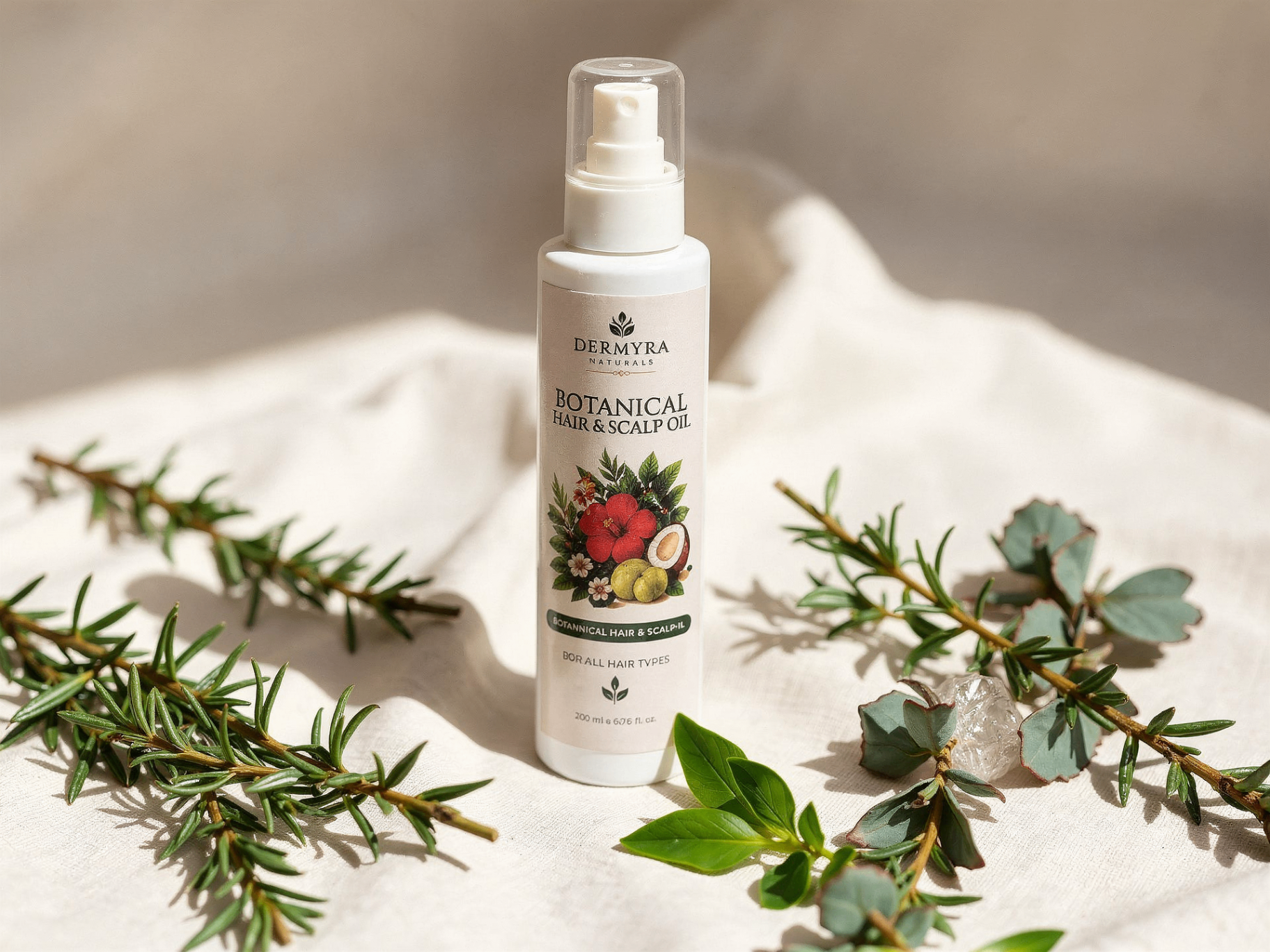
Dermyra Botanical Hair & Scalp Oil was formulated around exactly the botanicals discussed above. rosemary, bhringraj, amla, black seed and 24 more. in a cold-pressed carrier blend that is light enough to wash out in a single rinse. Nothing in the formula is there for fragrance or colour. Every ingredient has a role, either in the shaft (conditioning, protecting) or in the scalp (circulation, calming, follicle support). Used two to three times a week for eight to twelve weeks, it is designed to be the topical half of a real anti-hair-fall routine. the diet, sleep and water side is up to you.
Conclusion
Hair fall in Pakistan is almost never one problem. it is water, weather, diet and stress stacking up on the scalp. Fix the environment your hair is growing out of, use a small set of proven botanicals consistently, and give it a full growth cycle before you judge the results. That is how you actually stop hair fall, not just chase it.
Where Dermyra hair oil fits in
Everything above works with whatever bottle you already own, but the base matters. Dermyra oil is a cold-pressed, mineral-oil-free blend of 28 botanicals, built for the way people actually use hair oil in Pakistan: a short weekly massage, one to three hours of contact time, then a gentle wash.
If you are shopping for the best hair oil in Pakistan, judge the label rather than the marketing. A genuine hair fall hair oil lists a cold-pressed carrier first, real botanical infusions such as rosemary, amla and bhringraj, and no paraffin. If flaking is your main concern, a dandruff hair oil should also stay light enough not to sit on the scalp between washes.
Dermyra hair oil was formulated around exactly those constraints, which is why the routine in this guide and the oil are designed to be used together.
Frequently asked questions
How can I stop hair fall in Pakistan naturally?+
Focus on the scalp, not just the shampoo. Use a botanical hair oil with rosemary, bhringraj and amla two to three times a week, wash with a sulphate-free shampoo, filter your final rinse if you have hard water, and support hair from inside with protein, iron and vitamin D.
How much hair fall is normal per day?+
Losing 50 to 100 hairs a day is completely normal. If you are consistently seeing clumps, a widening parting or a thinner ponytail, that is when shedding has crossed into hair loss and needs a proper routine.
Does hard water in Pakistan really cause hair fall?+
Hard water does not directly kill follicles, but the mineral build-up dulls the scalp, makes products less effective and worsens breakage. which looks and feels exactly like hair fall. A final rinse with filtered water once a week helps a lot.
How long before I see results from a hair fall routine?+
Most people notice less shedding within four to six weeks and visible density changes after around three months of consistent use, because hair grows roughly one centimetre a month. Real change takes a full growth cycle.
Is Dermyra safe for oily or acne-prone scalps?+
Yes. The blend is lightweight and washes out easily. Use a smaller amount, apply directly to the scalp rather than the lengths, and always wash within 24 hours of application.