
Botanical Hair Oil vs Chemical Hair Oil: An Honest Comparison
Summary
- "Chemical" does not mean harmful; both botanical oils and formulated oils are made of chemical compounds, some natural, some synthetic
- Botanical oils tend to win on scalp nourishment, traditional use history and ingredient transparency
- Formulated oils with silicones tend to win on instant shine, frizz control and consistency across humidity levels
- Cost, shelf life and skin sensitivity differ meaningfully between the two categories and should factor into your decision
- Combination approaches, a botanical oil for scalp and pre-wash treatment plus a lightweight finishing serum, work well for many people
- The honest answer to "which is better" is that it depends on whether your priority is long-term scalp health or immediate cosmetic finish
- Patch test any new oil regardless of category, since sensitivity is individual, not determined by whether something is labelled natural or synthetic
I want to start by clearing up a phrase that gets thrown around loosely: "chemical-free." Every hair oil, whether it is cold-pressed from amla seeds or manufactured in a lab with dimethicone, is made entirely of chemical compounds. Water is a chemical. Vitamin E is a chemical. What people usually mean by "chemical hair oil" is a formulated product built primarily around synthetic conditioning agents like silicones, mineral oil derivatives or synthetic esters, as opposed to a "botanical hair oil" built primarily around plant-derived oils and herbal extracts. I will use those terms in that practical sense throughout this guide, but I think it is worth saying upfront that neither category is inherently dangerous, and neither is automatically superior. Let us look at what each one actually does.
What botanical hair oils are actually made of
A botanical hair oil is typically a base carrier oil, things like coconut, sesame, castor or sunflower oil, infused or blended with herbal extracts such as amla, bhringraj, rosemary, hibiscus, fenugreek or black seed. These oils have been used across South Asia for generations, and while folk use does not equal clinical proof, some of these ingredients now have modest research support. Rosemary oil, for instance, was compared to 2 percent minoxidil in a small 2015 SKINmed trial and produced comparable results in hair count after six months, with less scalp itching reported. Amla has documented antioxidant activity and traditional use for scalp conditioning. Bhringraj has some early animal-model evidence for promoting hair growth, though larger human trials are still limited.
The main strength of botanical oils is what they do for the scalp and hair shaft over time: reducing protein loss during washing (a mechanism well documented for coconut oil specifically, since a widely cited 2003 Journal of Cosmetic Science study measured lower protein loss with coconut oil compared to mineral oil), providing mild antioxidant and anti-inflammatory activity at the scalp, and generally being gentle enough for daily or near-daily use without buildup for most people.
What formulated "chemical" hair oils are actually made of
Formulated hair oils sold in pharmacies and on Daraz often use a light mineral oil or synthetic ester base combined with silicones such as dimethicone or cyclomethicone, sometimes with a small percentage of botanical extract added mostly for the label and fragrance. Silicones are not harmful ingredients; they are extensively studied, widely used across the cosmetics industry, and they do something botanical oils genuinely cannot do as effectively: they coat the hair shaft with a smooth, even film almost instantly, which reduces frizz and adds shine within minutes of application, regardless of humidity.
This is a real, legitimate benefit, particularly for people dealing with frizz in Karachi's humidity or looking for a quick finishing product before an event. The tradeoff is that silicone-heavy formulas sit on the surface rather than interacting with the hair shaft the way lipid-rich botanical oils can, so their benefit is largely cosmetic rather than restorative, and some heavier silicones can build up over time if you do not use a clarifying shampoo periodically.
Botanical oil vs chemical oil: side by side
| Factor | Botanical hair oil | Formulated ("chemical") hair oil |
|---|---|---|
| Primary mechanism | Penetrates shaft partially, reduces protein loss, nourishes scalp | Coats shaft surface, seals cuticle, adds instant shine |
| Speed of visible result | Gradual, noticeable over weeks | Immediate, visible within minutes |
| Frizz control in humidity | Moderate, varies by base oil | Strong and consistent |
| Scalp benefit | Higher, especially with active botanicals like rosemary or bhringraj | Minimal unless actives are added |
| Buildup risk | Lower for light oils, higher for heavy oils like castor if overused | Can build up with heavy silicones if not clarified regularly |
| Ingredient transparency | Usually simple, recognisable ingredient list | Often longer, more technical ingredient names |
| Typical cost in Pakistan | PKR 800 to 2,500 for a quality cold-pressed blend | PKR 300 to 1,200 for mass-market formulated oils |
| Shelf life | Shorter, especially cold-pressed oils without preservatives, 6 to 12 months once opened | Longer, often 2 to 3 years due to stabilisers |
| Best suited for | Long-term scalp health, thinning or dry hair, traditional oiling routines | Quick styling finish, frizz control before an event, low-maintenance shine |
Which is better for scalp health?
Botanical oils generally have the edge here, and this is not a marketing claim, it follows from what the ingredients actually do. Massaging a scalp with an oil containing rosemary or bhringraj brings mild circulatory stimulation from the massage itself plus whatever active compounds those botanicals contribute. Formulated oils built around mineral oil or silicone are largely inert on the scalp; they are not harmful to a healthy scalp in normal use, but they are not doing anything for it either beyond whatever moisture they trap. If your main concern is an itchy, flaky or thinning scalp, botanical oils with actual active ingredients, not just a botanical name on the label, are the more logical choice.
That said, I want to be fair here: for someone with a perfectly healthy scalp who just wants smoother, shinier hair for a wedding or event, a formulated oil is not doing anything wrong by skipping scalp benefits. It is simply built for a different job.
Which is better for the hair shaft itself?
For reducing breakage and split ends over time, botanical oils with a good fatty acid profile, coconut in particular, have real evidence of reducing water absorption into the shaft during washing, which lowers swelling-related stress and protein loss. This is a genuine mechanism, not folklore. Formulated oils reduce visible frizz and add shine by coating the surface, which does reduce friction-based mechanical damage somewhat, but does not address the internal protein loss the way penetrating oils can.
In practice, a lot of people get the best result from combining approaches rather than picking a side: a botanical oil as a pre-wash treatment for scalp and shaft health, and a small amount of a lightweight formulated serum on dry ends afterward for finishing shine. There is nothing dishonest or inconsistent about using both; they solve different problems.
Safety and sensitivity: where the fearmongering goes wrong
A lot of marketing around "natural" products implies that synthetic ingredients like silicones or mineral oil are inherently toxic, and I think that claim does customers a disservice. Cosmetic-grade mineral oil is highly refined and considered safe for topical use by dermatology bodies; it is not the same as industrial mineral oil. Silicones are some of the most extensively tested ingredients in cosmetic chemistry and are non-comedogenic on hair (they can be an issue on acne-prone skin if it gets on the face, which is a separate concern from hair use). The honest safety concern is not "natural versus chemical," it is individual sensitivity and formulation quality. Some people react to essential oils in botanical blends (tea tree and certain citrus oils are common sensitisers) just as some people react to certain preservatives in formulated products.
Always patch test
Regardless of whether an oil is botanical or formulated, apply a small amount behind your ear or on your inner arm and wait 24 hours before using it on your scalp, especially if you have eczema, psoriasis or a history of skin sensitivity. This applies equally to both categories; category alone does not predict individual reaction.
Cost, shelf life and everyday practicality
Botanical oils, particularly cold-pressed ones without synthetic preservatives, usually cost more per bottle and have a shorter usable shelf life once opened, typically 6 to 12 months before the fatty acids start to oxidise and the smell turns slightly rancid. Formulated oils with stabilisers and synthetic preservatives can sit on a shelf for two to three years without much change. If you are someone who buys hair oil rarely and wants it to last, that is a genuine practical point in favour of formulated products. If you oil weekly and go through a bottle in two to three months anyway, shelf life stability matters less.
On price, mass-market formulated oils sold at pharmacies are often cheaper per bottle, partly because mineral oil bases are inexpensive and partly because they are produced at very large scale. Quality botanical oils cost more because sourcing real amla, bhringraj or rosemary extract, and using enough of it to matter, is genuinely more expensive than a mineral oil base with a trace amount of fragrance. Some budget "herbal" oils on the market use a tiny amount of botanical extract mainly for the scent and green colour, which is worth knowing if you are paying a premium expecting a strongly active formula.
How to actually decide between them
I would frame the decision around your primary goal rather than a general belief that one category is better. If you are dealing with thinning, dryness, dandruff or a scalp condition you want to manage gently over months, a botanical oil with genuinely active ingredients, applied consistently as a pre-wash treatment, is the more logical starting point. If your hair is generally healthy and your main complaint is frizz, flyaways or dullness that you want fixed before you leave the house, a formulated finishing product does that job efficiently and there is no reason to feel guilty about reaching for it.
Quick decision checklist
- Want scalp benefits (anti-inflammatory, circulation, traditional actives) — choose botanical
- Want instant shine and frizz control before an event — choose a formulated finishing oil
- Dealing with thinning or hair fall — choose a botanical oil with researched actives like rosemary
- Live in a very humid city and struggle with frizz daily — a light silicone-based product may serve you better as a top layer
- Prefer a short, recognisable ingredient list — choose botanical
- Need a product that lasts years unopened on a shelf — formulated oils generally have longer stability
- Want the benefits of both — use a botanical pre-wash oil weekly and a small amount of finishing serum on dry days
Botanical vs chemical hair oil: pros and cons at a glance
Where botanical oils generally win
- Genuine scalp-level benefits when actives like rosemary or bhringraj are included
- Reduced protein loss during washing, especially with coconut-based blends
- Shorter, more transparent ingredient lists
- Fits naturally into traditional weekly oiling routines
- Lower risk of surface buildup with lighter oils
Where formulated oils generally win
- Instant, consistent shine and frizz control regardless of humidity
- Longer shelf life due to stabilisers, useful for infrequent users
- Often lower upfront cost at mass-market pharmacy price points
- More predictable, uniform texture batch to batch
- Lighter feel for people who dislike the heaviness of some plant oils
Myths worth retiring on both sides
On the botanical side, the myth that needs retiring is that "natural" automatically means safer or more effective. Poison ivy is natural. Some essential oils cause real contact dermatitis. Effectiveness depends on the specific active, its concentration, and how it is formulated, not on whether it came from a plant. On the chemical side, the myth that needs retiring is that silicones "suffocate" hair or cause permanent damage. Hair has no cells to suffocate, and modern silicones used in leave-in and rinse-out products are generally well tolerated; the real, minor downside is buildup if you never clarify, which is a maintenance issue, not a toxicity issue.
I would also push back gently on the idea that you have to pick a tribe here. Plenty of good routines use a botanical oil for scalp treatment and pre-wash conditioning, and a small amount of a formulated serum for finishing on dry days. There is no ideological conflict in that combination; it is just using the right tool for each specific job.
Where a product like ours fits into this comparison
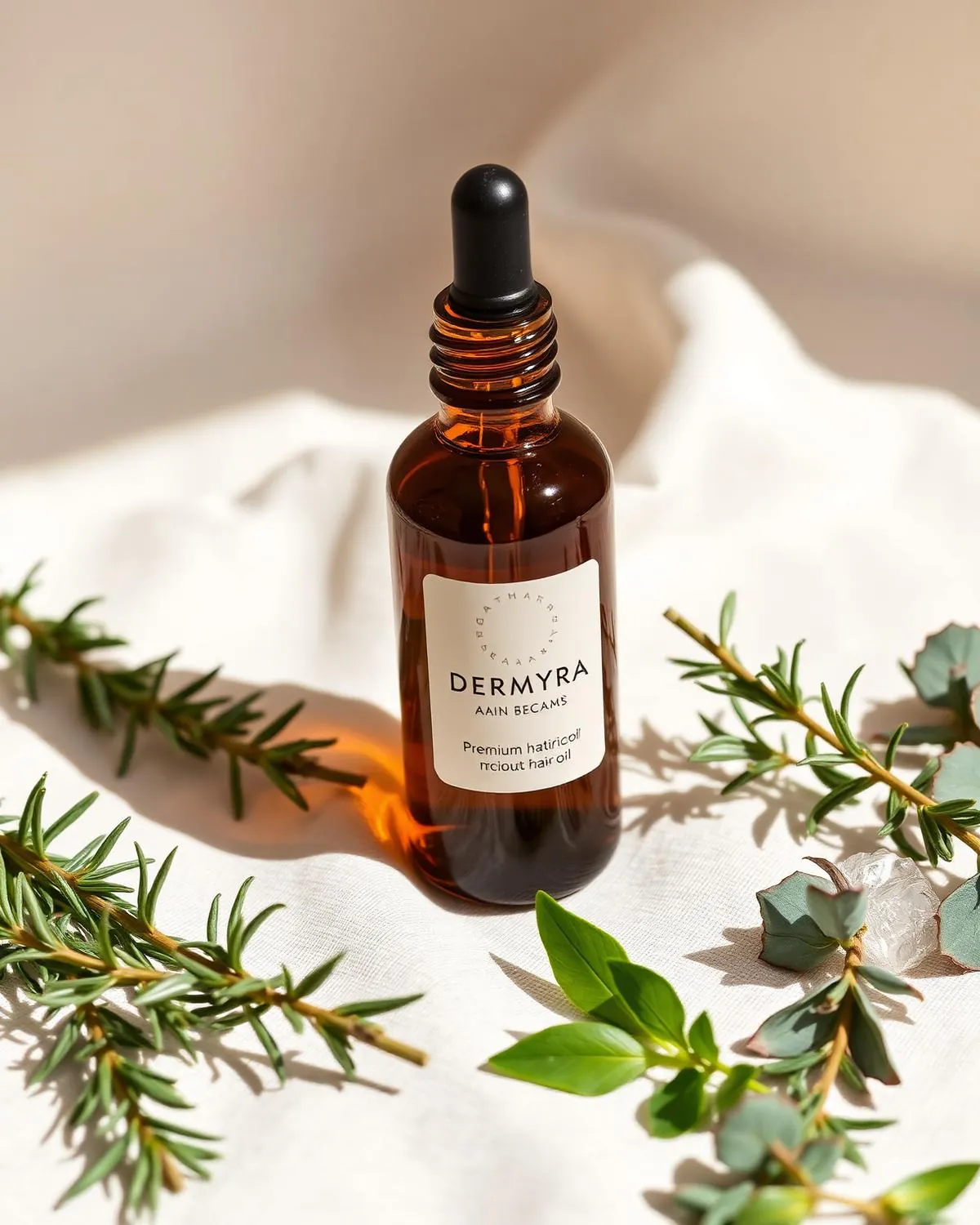
Our Dermyra Rosemary Hair Growth Oil sits firmly in the botanical category: rosemary, amla, bhringraj and 28 botanicals in a cold-pressed carrier oil base, without added silicones. We built it this way because our focus is on the scalp and pre-wash conditioning use case, not on providing instant finishing shine. If your priority is a fast-acting anti-frizz product for a night out, that is genuinely a different product category and we would rather say so plainly than blur the line with vague marketing language.
See the full ingredient list
If you are choosing a botanical oil, the ingredient percentages matter more than the front-label claims. Compare our formulation on the product page or browse individual ingredient guides like rosemary and amla to understand what each one is actually doing.
The honest, unglamorous conclusion
Neither category is a scam and neither is a miracle. Botanical oils earn their place through slower, scalp-level benefits backed by a mix of tradition and modest research. Formulated oils earn their place through fast, dependable cosmetic performance backed by decades of cosmetic chemistry. The wrong move is assuming either label tells you everything about safety or effectiveness. The right move is reading the actual ingredient list, matching the product to your actual goal, and giving whichever one you choose a fair, consistent trial before deciding it does or does not work for you.
Related reading
Frequently asked questions
Is a botanical hair oil always safer than a formulated one?
Not automatically. Safety depends on the specific ingredients and your individual sensitivity, not on whether a product is labelled natural or synthetic. Some botanical ingredients, particularly certain essential oils, cause real sensitivity in some people, just as some synthetic preservatives do. Patch testing matters more than the category label.
Do silicones in hair oil actually damage hair?
Modern silicones used in cosmetic formulations are well studied and generally well tolerated on hair. They do not chemically damage the shaft. The realistic downside is surface buildup with heavy or frequent use if you never use a clarifying shampoo, which is a maintenance issue rather than a safety concern.
Why do formulated oils show results faster than botanical ones?
Formulated oils typically use silicones that coat the hair shaft and reflect light almost immediately, producing instant shine and reduced frizz. Botanical oils work more gradually through partial penetration into the shaft and cumulative effects on the scalp, so their benefits build over weeks rather than appearing in minutes.
Can I mix a botanical oil with a formulated finishing product?
Yes, and many people get the best practical results this way, using a botanical oil as a pre-wash scalp and shaft treatment and a small amount of a formulated serum for finishing shine on dry hair days. The two serve different purposes and are not chemically incompatible.
Which type of oil is better for hair fall?
Botanical oils with researched actives, particularly rosemary, have more direct evidence relevant to hair fall, including a 2015 SKINmed trial comparing rosemary oil to minoxidil with comparable results. Formulated oils without added actives are not typically marketed or studied for hair fall specifically.
Are cheaper pharmacy hair oils always lower quality than botanical ones?
Not necessarily lower quality for their intended purpose, but often built with a different goal: mineral oil bases with minimal actives, designed for cost efficiency and cosmetic finish rather than scalp treatment. They can do their intended job well; it is just a different job than a concentrated botanical blend.
How long can I keep a botanical hair oil before it goes bad?
Most cold-pressed botanical oils without synthetic preservatives last 6 to 12 months once opened before the fatty acids begin to oxidise, which shows up as a slightly rancid or sour smell. Store the bottle away from direct sunlight and heat to extend this, and discard it if the smell changes noticeably.
Does "chemical" on an ingredient list mean it is harmful?
No. Every ingredient, plant-derived or synthetic, is technically a chemical compound. The word alone tells you nothing about safety or effectiveness. What matters is the specific ingredient, its concentration, and how your skin or scalp individually responds to it.
Is it true that natural oils penetrate hair better than synthetic ones?
Some natural oils, coconut oil being the best documented example, do measurably reduce protein loss by partially penetrating the hair shaft, which is a real mechanism supported by lab studies. This is specific to certain fatty acid structures, though, not a universal rule that applies to every plant oil versus every synthetic ingredient.
Which should I choose if I have a sensitive or eczema-prone scalp?
Choose based on ingredient simplicity and patch test regardless of category. Fragrance-heavy formulas and strong essential oil blends can both trigger reactions on sensitive skin. A simple, well-tolerated botanical oil with minimal added fragrance is often a reasonable starting point, but always test a small area first.
The bottom line
The botanical versus chemical debate gets more heated than it needs to be, mostly because marketing on both sides oversimplifies to sell a story. Botanical oils generally do more for long-term scalp health and shaft condition; formulated oils generally do more for immediate cosmetic finish. Neither claim needs fear or hype attached to it. Pick based on what you are actually trying to solve, read the ingredient list rather than the front-label claims, patch test anything new, and feel free to use both types for different purposes if that genuinely serves your hair better than picking a side.
How Dermyra oil supports this routine
A routine only works if the oil behind it can do the job. Dermyra hair oil is a 28-botanical, cold-pressed blend made for Pakistani conditions: hard water, heat, dust and the weekly champi habit most households already keep.
As a hair fall hair oil it concentrates rosemary, amla and bhringraj at the scalp, where shedding is actually decided. As a dandruff hair oil it avoids the heavy paraffin bases that trap flakes and sweat against the skin. And as an everyday hair oil in Pakistan it is deliberately light, so 5 to 15 ml per session is genuinely enough.
If you are comparing options for the best hair oil in Pakistan, compare ingredient lists side by side — that comparison is the reason Dermyra oil exists.
Keep reading
- Best hair oil in PakistanHow popular market options compare on ingredients and price
- Cold-pressed hair oils explainedWhat cold-pressing actually changes about an oil
- Rosemary oil for hair growthThe research behind rosemary oil and hair growth
- Benefits of amla for hairWhat amla actually does for scalp and shaft health
- Hair oiling routine, step by stepHow to apply oil correctly for real benefit
- Shop Dermyra Rosemary Hair Growth OilOur botanical formulation with rosemary, amla and bhringraj
- Full ingredients listSee every botanical we use and why
One bottle, 28 botanicals
Dermyra Rosemary Hair Growth Oil brings rosemary, amla, bhringraj and black seed together in a cold-pressed base. Made in small batches in Pakistan.
Related guides
Benefits of Amla for Hair: Tradition, Evidence and How to Use It
Amla shows up in nearly every desi hair oil ad, but what does it actually do for your scalp and strands? Here is an honest breakdown of the tradition, the research and how to use it well.
Benefits of Bhringraj for Hair: The King of Herbs, Examined
Bhringraj carries the biggest reputation of any Ayurvedic hair herb, sometimes called the king of herbs. Here is what actually backs that title, and what it does not.
Benefits of Black Seed Oil (Kalonji) for Hair and Scalp
Kalonji has a thousand-year head start in traditional medicine and a growing pile of lab studies on thymoquinone. Here is what actually holds up when you separate the folklore from the evidence, and how to use it on your scalp safely.